
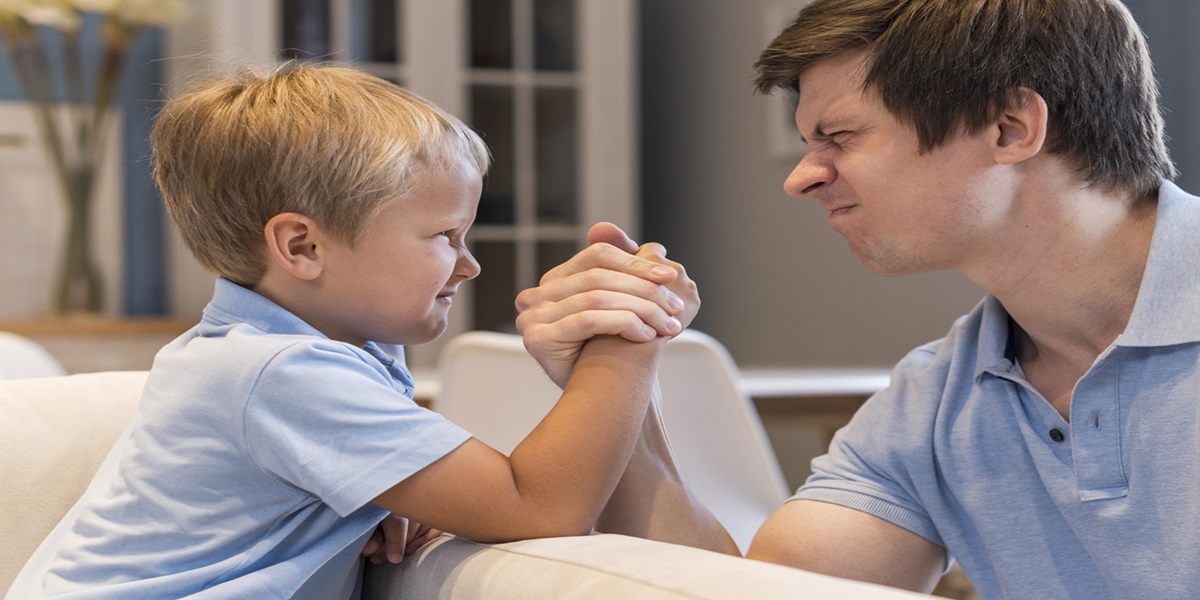
How to treat your child!It is better how you can
A friend of mine has three amazing children! They pick up their toys by themselves, go to bed on time without haggling, they even settle their differences by themselves! These guys are amazing! I even once saw his three-year-old son calmly deal with a child who had snatched his toy truck from his hand. Believe me, I’m not kidding, these guys exist! We too can be parents of one of these children, if we know how to treat our child.
My friend believes that her children should also have some time for themselves; First of all, they are children and they should be children! But he believes that a little educational challenge is also necessary. I asked him the secret of his work and I hope to be able to convey some wisdom of his training method to you.
In order to understand the secret of my friend’s success, I asked him what his method is. Does he threaten his children? If they don’t listen to him, will he punish them? Does it give them a lot of free time? Or does he bribe them with food in exchange for listening to him? My friend was shocked by my questions and said, “No, it’s not like that at all!” I try to do the most correct thing to raise them and make it clear to them what I expect from them. Now I just have to look at them, they will understand themselves that they should be organized and how to behave!”
This method can be very good if done right. Dr. Sharon K. Hall, author of the book “Raising Children in the 21st Century”, says: “If you clearly define your expectations when your children are still toddlers, these expectations will be institutionalized in them, and from then on, they will be the same.” They will have expectations from themselves.” In other words, because children naturally want to please their parents, they try to behave as you have taught them to do. Experts say that children have an empathetic behavior from the age of 18 months and respond to their parents’ expectations.
Dr. Robert Brooks, one of the authors of the book “Raising a Disciplined Child” says: “If you start teaching your child when he is still 2 years old, the child will learn faster, show less resistance and ultimately behave better. Will have”. He believes that each of the things that we will mention below are essentials that will help you raise a child who knows how to behave.
✅Part 1: Set firm and respectful rules
1. Explain why…
You don’t need to give comprehensive and complete explanations for what you want your child to do or the rules you set for him. But if he knows there are convincing reasons, he will be less stubborn. For example, if you have arranged for him to go to bed at 8 o’clock, tell him that this is necessary because it will keep his body strong and healthy. Or if you tell him to put away his toys, it’s because he won’t be looking for them the next time he wants to play.
2. Compliment him
Praise your child whenever he follows the rules or does something positive. Dr. Larry J. Koenig, author of Smart Parenting, says: Be sure to praise your child when he makes his bed or lets his sister play with her toys. Tell him: “What a great boy I have who makes his own bed and does his own chores.”
3. Follow the rules yourself.
4. Cultivate the child’s conscience
If your child feels bad for disobeying your rules, try to minimize that bad feeling. It is true that a little sense of guilt is necessary for a child; because he must be able to recognize right and wrong and try to move in the right direction; But remember to take advantage of such events as an educational opportunity. Dr. Hall suggests telling the child in these situations: “I know it’s sad, but we all make mistakes, we just have to be careful not to repeat it next time.”
✅Part 2: Teach him problem-solving skills
One of the biggest reasons for children’s bad behavior is their sense of helplessness and hopelessness. Dr.
Brooks believes in this field that when children have the tools they need to discover themselves, they behave better because in this case they take better care of themselves and, as the famous saying goes, they make less of your voice! And when faced with challenges, they act correctly.
1. Allow the child to make decisions.
2. Encourage him to try again and again.
3. Train your child to consider all aspects of everything.
Enhance your child’s cognitive skills to challenge themselves. For example, when he asks you how he should do something, answer him with a question. For example, say: “What do you think you should do?” With this question, you will raise his self-confidence and help him think about deeper issues and have the right attitude.
✅Part 3: Help your child practice waiting
No one likes to wait, especially children and teenagers; Because their evolutionary and nervous structure is such that they like to figure things out sooner. It is better to teach him patience when he is a toddler. It may be a little difficult and the child may resist or get upset, but this will help him to deal with issues more easily in the future and it will not be difficult for him to wait, and of course, if he had to wait for something or work, he would not have unpleasant behaviors.
1. Let him wait
Whatever he asks for, don’t give it to him right away! Dr. Osit says in this context: “Let your child experience the unpleasant feeling of waiting; Because this is a big and important change. Help your child manage his impatience.
2. Talk to your child about his feelings
When a toddler waits, he cannot express his frustration and despair! But you can name his different feelings and help him express them. On the other hand, when he succeeds in waiting for something, encourage him. If your preschooler is able to persevere with something, tell her, “I know it’s hard to wait, but you did it, and that’s great.” You waited.” Dr. Brooks’ opinion on this is that if you value your child’s patience, he will be encouraged to try harder and wait long enough to get results.
3. Involve your child in things that require patience
Encourage children to do things that don’t pay off immediately and take time to bear fruit. For example, ask him to build a different and slightly more complicated structure with his Legos, buy him a puzzle, and ask him to plant flower seeds with you and take care of them until they grow green. Make sure that the child is not constantly entertained with all kinds of gadgets and computer games that can only be answered by pressing a button!
✅Part 4: Emphasize “Empathy” a lot
How many times have you highlighted your child’s work when he shared his toy with his friend or sister? Did you even think that you should care about this issue?! Dr. Steven E. Curtis says: “People grow up with the mentality that the whole world revolves around them, so teach them from childhood that all people have feelings, they understand, and the emotions of others are important too!” If the child grows up like this, he is less likely to misbehave or harm others in the future.”
1. Appreciate your child’s kindness.
Child psychologist Lisa Aaron believes that it is better not to miss natural opportunities to teach children empathy. He says: “When you see your child behaving considerately towards another, you should also give him proof of this behavior. For example, if you see her putting a blanket on her doll, say: “What a good thing you did, the weather is cold, she might catch a cold.”
2. Instead of explaining, ask him questions
You can’t explain empathy to a toddler. Children are not in a condition to listen to other people’s speech. Here’s what you need to do: Help them think about other people’s feelings. If you ask them, their mind will be used and they will understand the feelings of others. For example, when your child won’t let his friend play with his doll, ask him: “How do you think your friend felt when you didn’t let him touch your doll?”
3. Teach your child body language
You know that facial expressions and body movements express people’s feelings. When you can understand these feelings, your empathy increases. “Did you see how happy he was when you cut your chocolate in half with your friend? Did you laugh? You made him happy.” Remind him in time to think about other people’s expressions that express their feelings. The child may not fully understand these behaviors at first, but little by little, he will understand and understand how his behavior can affect others. We know that it is not possible to train a child and teach him order and order overnight! Many times your child may be rude or misbehave no matter how hard you try. Do you remember what my friend said? “After all, they’re just kids” That’s it! Try! Sooner or later you will get an answer and your beloved child will learn to behave better and better even when you are not present. Be sure!